01 · Analyst verdict
Credible origin, real buyers — and a growth case that outruns the track record.
HSG has earned the right to a diligence process. The quality and buyer relationships are documented; the scale-up is not yet. The structure should reward proven execution in trading first and fund the roasted brand in tranches.
Recommendation
Advance to diligence
Pursue with tranche-based funding: release trading working capital and legacy settlement at close, estate CAPEX on irrigation milestones, and roasted-brand capital on pilot sell-through.
What supports the thesis
- Verified quality: three national Top-10 Taza Dorada finishes (up to 90.55 pts) and repeat buyers like ONA, Phil & Sebastian and Standout.
- Bottom-up capital ask: $1.8M is derived from a $1.58M peak core draw plus explicit contingency, not a round number.
- Fast cash engine: domestic trading can activate within weeks and recycles working capital across harvest cycles.
- Disciplined optionality: capsules, RTD, tourism and an owned roaster are excluded from the base case.
What needs proof
- The long-term case leans on a new roasted brand: 59% of 2036 revenue from a line that has no sales today.
- Year-one export volume (100t) is double the best year ever commercialized (50t+) across all channels.
- ~$535k of the commitment settles legacy liabilities rather than funding growth.
- Free cash flow stays negative through 2029; cumulative FCF only turns positive in 2031.
02 · Base-case financials
EBITDA grows almost twice as fast as revenue.
The memo reports 2027, 2028, 2029, 2031 and 2036. Gap years (faded, marked *) are interpolated at constant growth so the curve can be read end to end; they reconcile to within ~4% of the memo’s $7.52M ten-year cumulative FCF.
Operating leverage
5.9% → 17.7%
EBITDA margin expansion as roasted mix and Europe scale.
Build-out burn
−$903k
Cumulative FCF across 2027–2029 before the platform self-funds.
Downside resilience
$2.82M
Ten-year cumulative FCF stays positive in the memo’s downside — 37% of base.
03 · Four engines
Trading funds the platform. Roasted coffee is where the value lands.
Short-cycle engines generate liquidity and supply; longer-cycle engines capture margin and build equity value. The revenue mix shifts decisively toward the roasted brand by 2036.
Revenue mix by engine
Domestic + estate is the residual of total revenue less reported roasted and export lines.
Roasted share of revenue
The roasted line is positioned at ~85 pts “affordable premium” under a new brand, keeping Santa Gertrudis for 86–90+ lots. That protects the estate name — but means the largest engine starts with no brand equity.
Domestic trading
Now / weeks
Buy and sell 84–85 pt green coffee inside Ecuador. Fastest to activate; recycles the same working capital several times a year and secures supply for every other engine.
- 2027 revenue
- $1.12M
- 2027 contribution
- $96k
- Contribution margin
- 8.6%
Direct export + HSG Europe
Now → scale
Physical exports from Ecuador plus an asset-light European hub (3PL, two sales trips a year) to serve fragmented roasters with shorter lead times.
- Export kg 2027 → 2036
- 100t → 280t
- Europe kg 2027 → 2036
- 17t → 108.5t
- Revenue 2036
- $3.82M
Estate production
Build / years
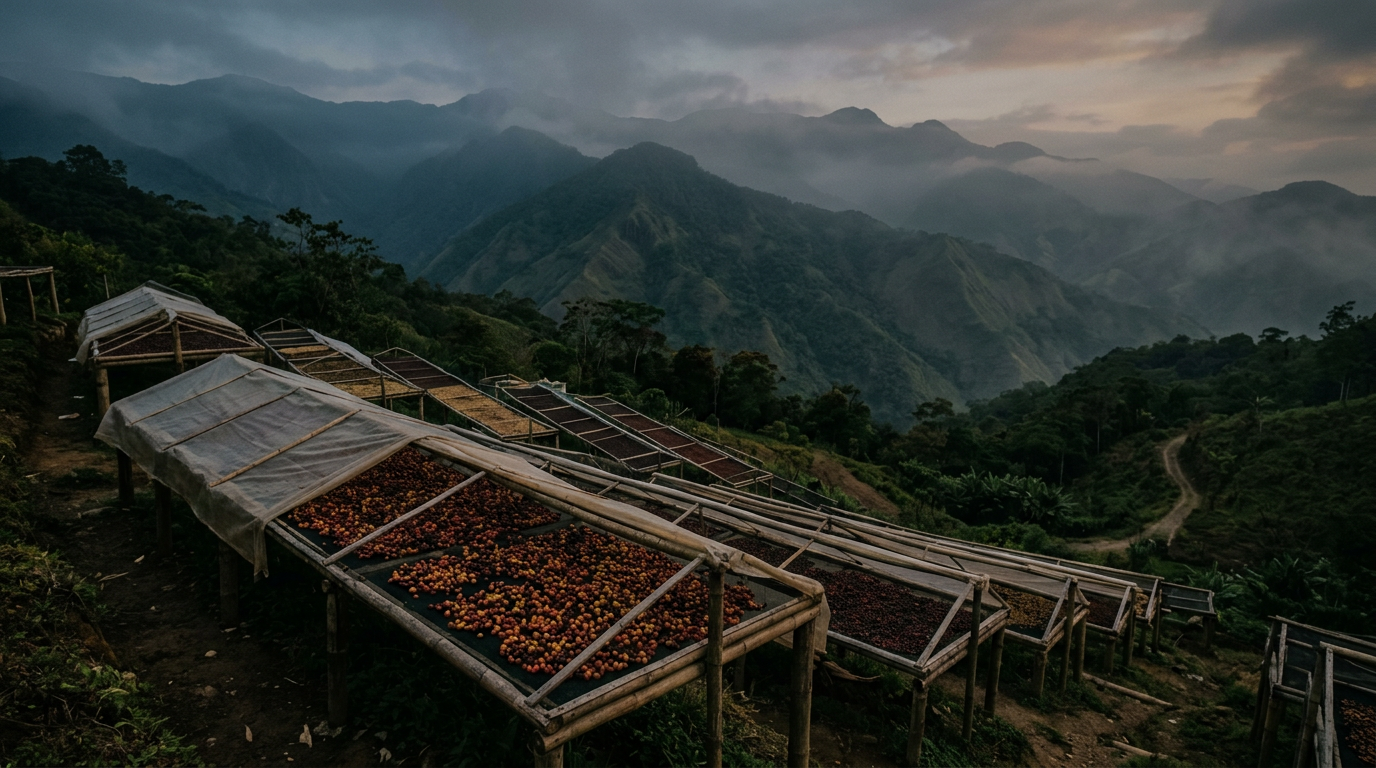
From 5 ha to 30 ha by 2029 at 1,680–1,970 m asl. Sidra, Geisha, Typica Mejorado and SL28. Origin validation, quality lab and patrimonial anchor.
- Hectares
- 5 → 30
- Output 2027 → 2036
- 2.8t → 25.8t
- Implied yield 2036
- ~858 kg/ha
Roasted coffee — Ecuador + Chile
Next stage
A new premium-mainstream (~85 pt) brand for retail and HORECA — not branded "Santa Gertrudis". Outsourced roasting; owned plant only past a volume gate.
- Volume 2027 → 2036
- 24t → 300t
- Revenue 2036
- $8.66M
- Contribution 2036
- $1.98M
04 · Capital & unit economics
The ask is built bottom-up. Know which dollars build and which settle.
Capital is an output of the operating model, not a headline. Fixed uses total $1.50M; the remaining commitment plus operating cash funds a working-capital peak of $808k that is recycled, not consumed.
Capital ladder
- Initial draw$882k
Closing, opening liquidity, cash protection
- Peak core draw$1.58M
Max cumulative facility use over 36 months
- Recommended commitment$1.80M
Core draw + $150k contingency + $70k gated
- Prudent envelope$2.00M
Fundraising headline with execution buffer
Fixed uses of funds
$1.50M of $1.80M- $535kLegacy resolutionInsurer, Municipality, legal & transaction costs
- $494kAgricultural CAPEX25 new ha, irrigation, water, estate facilities (2027–29)
- $345kLiquidity protectionCash reserve, debt-service reserve, contingency
- $60kRoasting launch reserveOutsourced roasting; no owned plant in base case
- $70kGated optionalityCapsules + drip bags, released only on validation
Legacy · Growth · Reserve — legacy settlement is 30% of the recommended commitment.
Roasted coffee — contribution per kg before marketing
HORECA beats retail in both markets; Chile retail is the thinnest channel before listing fees and rebates.
| Channel | Consumer price | Net / kg | COGS / kg | Contribution | Margin |
|---|---|---|---|---|---|
| Ecuador HORECA 1 kg | USD 24.00 / kg | $22.80 | $13.51 | $9.29 | 40.7% |
| Ecuador retail 250 g | USD 8.99 | $23.28 | $15.76 | $7.52 | 32.3% |
| Chile HORECA 1 kg | CLP 23,900 (~USD 24.38) | $23.16 | $15.76 | $7.40 | 32% |
| Chile retail 250 g | CLP 10,990 (~USD 11.21) | $23.74 | $18.01 | $5.73 | 24.1% |
05 · Returns workbench
What does an equity cheque need to look like?
The memo leaves structure open — equity, preferred, structured debt or hybrid. This workbench models a simple equity entry: exit value is EBITDA × multiple plus cash retained in the business (no distributions). Assumptions are the analyst’s, not the company’s.
- Implied post-money
- $5.14M
- Entry × 2028 EBITDA
- 17.0×
- 2036 EBITDA
- $2.57M
- Exit enterprise value
- $17.99M
- Retained cash at exit
- $7.22M
- Investor proceeds
- $8.82M
Paying 17× forward EBITDA prices in most of the roasted-brand success. Consider a lower post-money, a liquidation preference, or tranches tied to trading and pilot milestones.
Gap-year values are interpolated from the memo. Haircut applies to EBITDA and positive FCF years only; build-out burn is kept at the base case. Gross of fees, taxes and dilution.
06 · Stress test
Where the model and the track record disagree.
Cross-checking the memo against the teaser surfaces a handful of assumptions worth pressure-testing — and a couple that hold up well.
Year-one export volume is 2× the best year on record
HighThe teaser cites 50,000+ kg commercialized in HSG’s strongest year (estate + fellow farmers, all channels). The model books 100,000 kg of exports alone in 2027 — on top of $1.12M of domestic trading.
Ask for · Signed LOIs or purchase history by buyer; supplier pipeline in kg by grade.
The 2036 case is mostly a brand that does not exist yet
HighRoasted coffee grows from $0 to 59% of 2036 revenue, and its $1.98M contribution is equivalent to 77% of 2036 EBITDA. The teaser’s 84+ specialty story is not where most modeled value sits.
Ask for · Pilot sell-through data in Ecuador/Chile, distributor terms, marketing budget per kg.
~30% of the commitment pays for the past
Medium$535k of the $1.8M commitment resolves legacy liabilities (insurer, municipality, legal). That capital creates no new earning power and should sit behind protections.
Ask for · Legal opinion on each claim, settlement agreements, and escrow-on-close mechanics.
Trading margins are thin; turns do the heavy lifting
MediumDomestic trading earns ~8.6% contribution. Returns depend on rotating working capital several times a year — a 60-day delay in buyer payments materially compresses ROIC.
Ask for · Historic cash-conversion cycle, buyer payment terms, credit-loss history.
Implied roasted price/kg rises ~2.3% a year
LowRevenue per roasted kg moves from $23.5 (2027) to $25.8 (2031) to $28.9 (2036). Reasonable with inflation, but Chile retail already carries the lowest contribution (24%) before listing fees and rebates.
Ask for · Retailer term sheets for Chile; price elasticity by channel.
Estate yield assumptions look grounded
LowOutput of 25,750 kg on 30 ha implies ~858 kg/ha at maturity — achievable for well-irrigated specialty Arabica with fertigation, and a small share of total revenue either way.
Ask for · Cohort yield curve by variety and irrigation design study.
Risk register — memo risks with analyst scoring
| Risk | Why it matters | Current mitigant | Likelihood | Impact |
|---|---|---|---|---|
| Working capital | Commercial growth absorbs cash before it converts to EBITDA. | Peak WC quantified at $808k; $2.0M envelope sized above need. | High | High |
| Agricultural execution | Expansion needs irrigation, nutrition and operating discipline. | Scheduled CAPEX, explicit yield curve, cohort planting. | Med | Med |
| Retail / supermarket entry | Listing fees, rebates and payment terms erode margin. | Conservative base case; validate terms before aggressive rollout. | High | High |
| Europe cost creep | Platform must scale without fixed cost getting ahead of volume. | Asset-light 3PL structure with lean commercial team. | Med | Med |
| New product distraction | Capsules and drip bags could consume capital prematurely. | Excluded from base case; gated $70k only on proven economics. | Low | Med |
| Legacy liabilities | Unresolved claims could exceed the $535k provision. | Provision included in uses; needs legal confirmation. | Med | High |
07 · Origin proof
The quality claim is the best-evidenced part of the deal.
Taza Dorada results provided independent validation; HSG then stopped competing to allocate scarce top lots directly to buyers — several among the world’s most respected specialty roasters.
Taza Dorada Ecuador
- Sidra-SL282022 · 4th place · Natural90.55
- Typica Mejorado2021 · 6th place · Washed89.46
- Geisha2021 · 10th place · Washed88.54
Selected buyers have privately cupped some lots higher — commercial feedback, not official scores.
Roasters selling HSG coffee
- ONA CoffeeAustralia · Project Origin / Sasa Sestic(opens in new tab)
- Phil & SebastianCanada · Sidra single-origin(opens in new tab)
- Standout CoffeeSweden · Extended-drying Typica Mejorado(opens in new tab)
- So Coffee RoastersPortugal · Producer feature(opens in new tab)
- Australia
- Canada
- United States
- South Korea
- Japan
- Sweden
- Netherlands
- Portugal
- Greece
- Switzerland
- Singapore
- China
08 · Optionality
Upside the base case deliberately does not count.
Keeping these out of the underwritten case is the memo’s most credible choice. Each could become a later tranche once its unit economics are proven.
Chile capsules & drip bags
Gated · $70kChile’s specialty market is growing fast, and compostable capsules are now produced locally. Capsules are among the highest-margin formats per kg. Released only after co-packing cost, packaging, pricing and reorder rates are validated.
Forbes Chile on local compostable capsulesOrigin tourism & hospitality
Separate business caseSanta Gertrudis sits 20 km from Vilcabamba and borders Podocarpus National Park (~560 bird species). Hacienda La Danesa is the reference model: premium experiential tourism built around a premium agricultural product.
Reference: Hacienda La DanesaOwned roasting plant
Not in base caseThe model keeps roasting outsourced. An owned plant passes the gate only when volume and annual savings justify the CAPEX — a sensible sequencing discipline.
Ready-to-drink
Not underwrittenMentioned in the teaser as downstream optionality. Treat as pure upside until unit economics and a channel partner exist.
09 · Next steps
Diligence request list.
The items that would most change conviction, ordered by how much of the model they underpin.
- 01Buyer-level sales history for the last three harvests (kg, price, grade, payment days).
- 02Signed or indicative offtake for 2027 export volume of 100,000 kg.
- 03Legal opinion and settlement status for every legacy claim in the $535k provision.
- 04Land title, water rights and canal access supporting the 30 ha plan.
- 05Roasted brand pilot: co-packer quotes, retailer terms in Chile, sell-through data.
- 06Monthly 36-month cash model behind the $882k first draw and $1.58M peak.
- 07Downside case assumptions driving cumulative FCF of $2.82M vs $7.52M base.
- 08Governance: board seats, information rights, use-of-proceeds controls by tranche.
Suggested structure to discuss
Tranche 1 at close (~$1.0M): legacy settlement into escrow, liquidity reserve and trading working capital. Tranche 2 (~$0.5M): estate irrigation and planting on title/water confirmation. Tranche 3 (~$0.3–0.5M): roasted brand scale-up on Ecuador/Chile pilot sell-through. Preferred equity with a liquidation preference aligns with the legacy exposure while preserving upside.